My African Christmas

Today is both the shortest and the longest day of the year, depending on which side of the equator you call home. While I am falling in love with the snow and the wintry charm of short days in London, I try to imagine South African sunshine lasting into long, balmy evenings. Please take up your gingerbread latte or chilled white wine, and join me on a journey through our Saffa Christmas.

My husband and I were both born in Zimbabwe; he to Scottish parents and me to South African parents. His family’s Celtic Christmas in Africa was always festive and loud, with lashings of alcohol, sword-dancing and tearful renditions of “My Ain Folk”. Ours usually involved a journey from Zambia or Zimbabwe to my parents’ home town of Cape Town, and loads of cousins and relatives and beaches and food. Together, we developed a Christmas tradition that merged the best of what we both knew and loved: booze and beaches. Not exclusively. Walk with me…

In our early married years, we would use every free moment, every spare dollar, to go and see a movie. Christmas Eve was the perfect opportunity to do just that, so that is something that we have done almost every year since we got married: a Christmas Eve movie. We took a break when our boys were small but roped them in as soon as they were old enough to sit through and enjoy a movie. It doesn’t have to be a Christmas movie, a feel-good movie will do, so “Love, Actually”, “The Holiday” and “The Chronicles of Narnia” have featured in our ritual on the night before Christmas.

Our drive home from the movie would always include a drive along Adderley Street – the high street through the centre of Cape Town – to see the Christmas lights (illuminations). These always incorporated nativity scenes alongside scenes of Africa. We would go home and sit by the decorated Christmas tree and, sometimes, sing Christmas carols together. We would all retire to bed, and – one by one – each of us would sneak back to the lounge to put Christmas gifts under the tree.

When our boys were small, we would put empty pillowcases at the ends of their beds, and Father Christmas would fill them during the night. Then he would have a mince pie and a cold drink (or a beer) that had been left for him next to the Christmas tree. He would usually leave a lovely letter for the boys too.

On Christmas morning, we would wake with the sparrows and launch into the excitement of wishing each other Merry Christmas and giving each other gifts. With paper and boxes all around, we would have coffee and mince pies for breakfast before either going to church, or preparing for the day ahead.

We always gathered together as family, and would alternate hosting the festivities at our various homes, although we always shared the catering. At our home, we made one long table that extended from one end of our dining room/lounge area to the wide-open French doors on to the swimming pool area on the other. The table would be set for around 20 people or more, depending on which brothers and sisters were in town. We would decorate the table with Christmas crackers and tinsel and bowls of nuts and chocolates along the length of the table. My sister-in-law made beautiful decorative little Christmas trees that would add creative charm to the table.

Everyone would arrive at around noon and share gifts with each other.  Some would have a cup of tea or coffee; others preferred cold drinks, wine or beer. Each person would add their contribution to the meal on to the sideboard, where the bowls of salads would line up under cover from the summer-time flies. Lunch would begin at around 2.30pm with the turkey and ham having been carved, and everyone helping themselves to the meat and salads. Yes, salads – the best thing for mid-summer!

With each person seated at the table, we would put on our paper hats from the Christmas crackers and open the bottles of champagne. With bubbles flowing freely, we would toast Christmas, each other and absent friends before beginning the meal. It was always loud, loads of laughter, the telling of lame Christmas-cracker jokes, the sharing of memories of Christmases gone by, more champagne and more and more and more food. Christmas pudding would make an appearance at the right time – usually flaming and filled with silver coins. I’m the only person in my family who likes Christmas pudding, but my boys always had some just for the coins!

After totally over-indulging at the table, we would all get up, find a comfy seat in which to settle and snooze, go out and laze on the lawn or a garden chair next to the pool, or go and find a bed to sleep off the meal for an hour or so. The afternoon usually flowed into an evening spent outdoors in the creeping, cooling darkness of the setting sun, splashes in the pool, cold drinks a-plenty and an endless supply of food if anyone had room for more.

Sometimes the teenagers of the family would head off to the beach for a while for a refreshing dip in the ocean. The beaches were always busy but always worth it to splash in the crashing, cooling waves of the beautiful Cape Town coastline.

At some stage, a number of us would gather in the kitchen to wash the dishes and put the food away, always accompanied by laughter and hilarity. The food would be shared out to go home again, although someone invariably ended up with lashings of turkey that would appear in various guises in meals for the next week or so! Noisy, laughter-filled farewells would take place in our driveway, as cars pulled away at the end of a perfect day.

Replete with food, love, family, laughter and sunshine, we would retire to our beds and snore before our heads hit the pillow. Although Christmas in Africa is slightly different from the northern hemisphere experience, the love, unique traditions, shared memories and joy at the significance of the celebration, transcend time and geography.

So on this winter solstice, my heart and my thoughts bask in the long day of Cape Town sun and my body shivers and freezes in the bitter cold short day of London. Technology keeps the two hemispheres together, the shrinking world makes contact with my precious family so easy, and I realise that straddling two worlds can be both tender and heartening. And I’m okay with that.

Sunshine signing off for today!

 

Childhood Christmas

Last night we went to our church carol service. It was a wonderful, cosy evening of Christmas celebration. The new gospel choir sang contemporary gospel songs, intertwined with old favourites and we sang along. Those carols transport me through years and countries to Christmases I have known and loved.

I think of my childhood in Zambia and going to a Christmas party at the sports club in Lusaka. The tall and kind-eyed clown took a keen interest in four-year-old me and kept coming over to chat to me, and ask me if I was having fun. I was always nervous of strangers and my wide eyes stared anxiously up at this plastic-nosed giant. I kind of liked him but wished he would leave me alone. It was only years later that I discovered that that clown was my Dad.

I remember being picked to be Mary in the nativity play at our church in Mazabuka. The boy I’d had a crush on was going to be Joseph; at the very moment he was picked, my crush ended. We had to walk arm-in-arm down the aisle to the awaiting nativity scene; I can’t tell you how awkward and uncomfortable I felt with the closeness of the boy I now preferred to admire from a distance.

Wherever we lived, church was our Christmas Day companion. I loved the carols but can remember longing for the singing to end so we could go home and open our presents and begin the long, exciting day of celebrations. I can remember countless “carols by candlelight” services where I hoped I would and wouldn’t set light to the brown paper bag hosting my candle.

My sons’ Christmas concerts in Cape Town were a delight. My younger son made a fleeting first appearance at his play-school concert as an angel. He walked on stage and immediately thought it better to observe from the safety of his mother’s lap, so he came down off the stage – in his white slip and silver tinsel halo – and sat on my lap for the rest of the concert.

He watched his older brother play the role of messenger, bringing scrolled news to the people of Israel. Dressed in a plastic shield and very short trousers, my older son recited his words and then began to torment the girl sitting next to him. She had a long, blonde plait and, when she stood up for her moment in the spotlight, he pulled her plait. She turned round, glared at him and made a fist at him. He giggled for the rest of the concert. So did we.

That same year, the boy playing the part of the innkeeper was quite overcome after voicing his “no room!” lines. He put both hands on his head and panted like a dog until Joseph and Mary found alternative accommodation.

When my younger son was about four years old, he asked me one Christmas evening to play the piano. We sat together on the piano stool and I asked him what he wanted me to play. “The piano, Mommy,” he said. I asked him what tune, and he said he just wanted me to play the piano. I suggested “Away in a manger”, and he nodded.

I began to play and he began to sing, at the top of his voice, “We three kings of Orientare!” He just needed accompaniment. Any accompaniment.

Snowy London town today feels a lifetime away from summer-time Christmas in Africa. I kind of love the wintry charm of Christmas in the north, but I would trade anything to celebrate this special holiday with my family. There’s always next year.

Sunshine signing off for today!

Why banking was never my bag

My father worked in the bank. As far as I know, he started out as a messenger and worked his way through the ranks to management. He retired after over 46 years of service. That’s some kind of commitment.

He never worked with technology. He poo-poo’d the idea of using an adding machine, preferring to trust his accuracy in casting the numbers manually. A bank lived and died on the quality of relationships it developed with its customers, and personal service was unquestionably its biggest asset. Customers would go into the bank to withdraw or deposit funds, would get to know the tellers and would meet with the bank manager to discuss their accounts and requests for loans or overdrafts or new accounts.

A bank manager wielded much power and my father, jokingly, would talk about meeting customers at the doorway to his office. He would welcome them, shake their hands and invite them into his office. As he took his seat, he would invite his customer to take a seat opposite him. The response would be, “Thank you, sir, but I’m quite comfortable here on my knees.”

Apart from visits to my dad’s hallowed office, I, too, enjoyed two brief forays into banking. Although I am clearly my father’s daughter, banking was never going to feature big on my horizon.

My first taste of banking was a short, holiday job I took when I was home from university. Along with a bunch of students of similar ages and persuasions, I worked for a few weeks in the musty, upstairs offices of the Bulawayo branch. I have no clue what our task was, but I do remember loads of boxes of forms and paperwork, and we had to do something with them. Watching paint dry would have been riveting in comparison.

We’d shoot the breeze as we ticked boxes – or whatever it was that we did – and we took far too many coffee breaks and watched the clock till we could take lunch, or knock off. Three weeks passed by in slow motion and, happy with the money we’d earned, we bid each other a relieved farewell.

Another holiday job presented itself during my Christmas holidays that year. The bank was hugely busy and under-staffed during the frenetic Christmas period, so they called in some extra pairs of hands. My job, strange as it was that I chose to accept it, was deposits-only teller.  With no training and some brief instruction, I took to the wooden counter like a duck to, um, treacle.

I didn’t suck at maths at school, but it was not a subject that brought me much thrill. I can do things with numbers, but I’ve never really wanted to. So taking on a job that required me to count money and balance the books with monotonous, daily regularity, seemed a bizarre way of spending half of my summer holidays. The money must have been good.

The large, gracious banking hall in Bulawayo was an architectural masterpiece from a bygone era. High ceilings, wood-panelled walls and a sweeping, wooden horseshoe of telling booths welcomed customers into the hushed heart of the bank. A security guard would guide customers to a single line where they waited for one of the tellers to become free. The telling booths were open, allowing face-to-face contact between tellers and customers. This was before the need for tellers to have reinforced, bullet-proof glass protecting them from their customers.

A second line was formed for deposits-only customers. My heart sank as the line grew daily and, as Christmas Day approached, my line dwarfed the other. It might also have been because I was slow. Heaven help me.

I had regular customers who would bring their cloth bags of loot and pour it out on to the counter: “Knock yourself out,” they would say to me. Or words to that effect.

I had one regular customer who worked in a furniture store on the next street. He would mince excitedly over to my counter every day. He would take the money out of the bag, hand it over to me, with his banking book, and then begin his daily gossip. I’m pretty good at multi-tasking but to listen and respond to gossip while I’m having to count money, record it accurately, add up all the totals and try and work out what I’m really supposed to be doing, was beyond me.

He was a delightful character, however. Always nattily dressed with hair over-styled and under-stylish, he would shift his weight from foot to foot as he trilled his long, frilly fingers together and told me what was happening behind the scenes in his store and with his customers, or where he’d partied the night before. He’d always give me an opportunity to “give the goss” from my side, but I usually looked up at him with an exasperated blank stare and wished he’d just be quiet. Fortunately he never got that I felt that way, and, once his book had been tallied and rubber-stamped, he’d twirl round and mince out of the bank like he was walking on air.

I also had regular visits from the newspaper sellers and hawkers who plied their trade on the streets outside the bank. These customers would usually have their loot tied into an old handkerchief and stored in their sock, or at least that’s the impression I got. I called those interactions the “smelly deposits”. Say no more.

One of my most embarrassing moments happened while I worked at that counter. Occasionally – like about a hundred times a day – I would need to leave my telling booth to go and ask someone what I was supposed to do in a particular situation. Or to take money to the safe. Or to fetch something. Each time I left, I’d have to make sure the bank’s rubber stamps were out of reach of the customers, retrieve my keys for the booth door and excuse myself as I went to look for some direction.

On one occasion, I did two of the three requisite things and left my booth. As I closed the door, with its Yale lock, I realised I had not taken my keys. I had just locked myself out of my booth. And I had a stranger-customer at my counter, waiting to complete his transaction. I broke into a cold sweat. I completed my enquiry mission, and then wondered how on earth I could discreetly walk into the banking hall and climb over the counter back into my booth to continue working with my customer.

For one who was not exactly a natural at telling, and who struggled most days to balance her books or do her job even vaguely well, this was a whole new challenge.

I am not the world’s greatest lateral thinker, but occasionally flashes of brilliance do cross my mind. I thought of a less embarrassing way to get back into my booth that didn’t involve pole-vaulting from the banking hall. I grabbed a chair, put it outside the back of my telling booth door, climbed up on to it and leaned up and over the top of the door – on tippy toes and probably groaning as I stretched to reach the lock – to unlock my door. I walked nonchalantly back into my booth to let my customer know what I had just found out for him.

It was difficult to maintain my dignity when I knew that the entire, busy banking hall was watching me. I tried to ignore the muffled giggles and guffaws from customers, security guards and fellow tellers. I glanced fleetingly at my watch and calculated – without the use of an adding machine – that it was only half an hour till closing time and in my mind I defied anyone to breathe one single word to me about what had just happened.

I finished with my customer and prepared to hold my breath; another customer was taking something out of his sock as he walked towards my counter.

Sunshine signing off for today!

Magic, mayhem and grass-heads at Christmas

Uncle Paul’s Christmas parties were always magical. I remember going to them when I was a child on holiday in Cape Town – way before the rindepest – and we took our boys to them when they were small.

It was an annual event that marked the beginning of Christmas festivities for us. We usually went early in December, and we always went with our dearest friends whose children were the same ages as ours. The weather was always good, the children always had fun and the enchantment of Christmas sparkled and shone under a royal blue, twinkling Cape Town sky.

Organised by local service clubs, Uncle Paul’s Christmas party is a not only a Cape Town institution but a significant fundraising event for local, deserving charities. With tickets almost as difficult to come by as Wimbledon Centre Court tickets, we’d have to book our berths early in the year, and wait in eager anticipation for the tickets to arrive, along with detailed instructions and our allocated date.

We’d arrive at the beautiful wine farm, show our tickets to the volunteers at the gate, and my husband would have to get out and hand over the carefully disguised swag from the boot of our car: a disposable container of food to contribute to the communal supper, a gift for an under-privileged child and a black bin-bag containing a gift (at a specified maximum price), labelled and chosen specially for each of our children. Our boys would keep their eyes focused ahead – they could barely contain their excitement.

We’d park our car, catch up with our friends, and join the queue for the tractor ride. Sitting on bales of hay in a trailer pulled behind a tractor, we would travel up to the bespoke castle at the top of the hill. Seating (for the adults) was arranged around a central, hay-filled area that faced the castle. We would find a place to sit and the children would jump into the hay, and begin their feast of hay-fights.

We were back-row parents. My friend and I would sit close to each other and catch up on the news and chat about everything we could think of. Our husbands would sit next to each other, share a few words here and there and laugh like drains. Such is the nature of our relationships. There was always plenty of laughter.

As soon as everyone had arrived at the castle, Noddy, Big Ears and Mr Plod would arrive and try and create order in the midst of the hayfights. This was always hilarious and over-the-top for the children, and they would try and bury the characters under the hay. The manic playtime would end with the welcome arrival of ice-creams for each child.

A marching band usually arrived after ice-creams, and the children would follow them as they marched this way and that. They would stop and play a few familiar tunes, and encourage participation from the children. By now, the light was starting to fade, and the communal supper would be passed around for all to share.

It was at this point that the Christmas carols would begin. And the laughter – from our quarter – became increasingly hysterical as our friend did his Elvis impersonation to each carol. He would sometimes liven up the songs with some hand-clapping or occasionally go reggae on us. It was hard to stay focused, but at least the children were sitting quietly in front of the band, singing as they should!

Usually the last carol to be sung was “Silent Night”, and it was at this point that the Christmas fairy would arrive. She was beautiful. She had a wand, and she would weave her magic as she lightly touched the tree and turned on the Christmas lights. The children would help with shouts of encouragement, and requisite oohs and aahs. As she was getting ready to light the star at the top of the tree, the children would be encouraged to be quiet as mice and listen; if they listened very carefully they could hear the sleigh bells in the distance. They came closer and closer, and the excitement and anticipation became almost too much to bear.

The fairy would light the star at the top of the tree and, as all little eyes were on her, Father Christmas would “land” on top of the castle. He would make his presence known, the children would look over at him and would screech and whoop and clap and jump around in excitement.

Father Christmas would come down from the top of the castle, sack on his back, and would dig into the sack to take out presents for each of the children. They would be called up in turn and, with shyness and wild excitement, the children would go up, look longingly into the eyes of this jolly man dressed in red, and receive their gifts. Paper was torn and tossed this way and that and the gifts were received with shrieks of joy.

Children would run around flashing their light sabres, wearing their neon head bands and bangles, playing with their action figures or rugby balls or toy drums (heaven help us) or toy cars and dolls. Sound effects rang through the air along with shrieks and laughter and vocal happiness.

One year, my friend had a great idea for gifts for all four of our little ones. She described them to me, and, encouraged by her enthusiasm, I agreed and went along with her. She bought the four items, wrapped them and surreptitiously passed two of them to me ahead of the Christmas party.

That was the year that all the children shrieked and laughed and showed off their gifts for all to see. Except our four children. Each of them took one look at their grass-head and came and sat quietly alongside us and watched longingly as the other children ran around and played with their cool toys. (The grass-head was a toy made out of an old stocking, filled with sand and grass seeds. The idea was that you put the grass-head on a jar filled with water, with its knotted bottom half dangling in the water. In time, the seeds would germinate and grass would begin to grow through the top of the stocking, creating a kind of long buzz cut: meet Mr Grass-head! It would be about six weeks before any “hair” appeared.)

My friend and I cast knowing looks at each other – what were we thinking? Our husbands looked at us less graciously, with expressions of WTF (why the funny-toy?), and our children sat there trying not to look ungrateful but so wishing they had cooler toys. What was Father Christmas thinking that year?

Fortunately “he” redeemed himself the next year with cool toys, and the children have long since forgiven us. It never detracted from the magic of Uncle Paul’s Christmas parties, but added a new dimension to our shared memories of those days.

Our four children still cannot figure out what we were thinking that year. I do wonder, myself, my dear dear friend: what were you we thinking?

Sunshine signing off for today!

A question of laughter

I have always been both teased and extolled by my family for being observant. Not to put too fine a point on it, my family members have said that when I’m around, they cannot get away with anything. I notice everything. Partly true; I notice everything that makes me laugh.

This morning I went to gym to do two classes: a Pilates class followed by a Swiss ball (exercise ball) class. We have a fabulous instructor and she puts on two kick-ass classes, providing excellent instruction along with a good workout.

The Pilates class had just finished, and preparations began for the Swiss ball class. Not everyone who does Pilates does the Swiss ball class, and vice versa. People leave and people arrive. Those of us who stayed, got our big blue balls, took them to our spots and sat and bounced on them as we waited for the class to begin. There were a good ten people sitting, bouncing on their balls when a new face appeared at the door. She half-opened the door, looked at all of us, looked at all of us again and then said, “Is this the Swiss ball class?”

Given that there is no other class offered at the entire gym at that time, that question struck me as, well, kind of obvious. “Duh,” was the kindest response that sprung silently to my mind. The more gracious among us said, “Yes.”

Some years ago, I travelled up to Harare, in Zimbabwe, from my home in Bulawayo, to spend a weekend with my sister. We had a fabulous weekend together, and bid a tearful, hugging farewell at Harare airport, from where I was to take the 40 minute flight home.

I checked in, got my boarding card and made my way on to the aircraft as soon as boarding opened. I took my window seat and settled down to read the in-flight magazine and reflect on my weekend fun. A guy came to sit next to me. He fiddled and fidgeted around a bit before settling down next to me. I was then aware of him having a bit of a long look at me and then he asked, “Are you going to Bulawayo?”

“No, I’ve asked the pilot to let me jump over Gweru,” was the answer I would have given, but my bemusement left me with, “Yes.” It also occurred to me that he could brush up on his pick-up lines.

My favourite stating-the-obvious moment happened when my husband and I were on our honeymoon. We stayed in a small cottage on the coast in northern KwaZulu Natal in South Africa. It was a small, simple, fishing cottage, owned by a friend’s father. The cottage had a small lawn in front of it, and in front of that was sand and sea for as far as the eye could see. A romantic hideaway indeed. We were entirely alone. (Apart from an unexpected and surprising visit from a Jehovah’s Witness on a Sunday morning!)

One day, we returned from a lovely walk on the beach and made ourselves a light lunch to enjoy outside with a good bottle of chilled, white wine. We languished on loungers and soaked in the warm, sea breeze and the joy of being newly-weds.

I leaned over to pour myself another drop of wine. I saw that my husband’s glass was also empty, so I looked adoringly into his eyes, and said, “Would you like some more wine?”

I have never let him forget his response: “Who, me?”

I guess my family members have a point when they say they can’t get away with anything when I’m around. But heck, it keeps the fun memories alive and isn’t it just great to laugh?

Sunshine signing off for today!

English as she is spoke

The thing about accents is that you only notice them when they differ from your own. At home in Cape Town I never notice my own accent but here in London, it’s another story all together. I’m well forrin and can’t hide it.

I heard the tail-end of a discussion on a TV talk show this morning. One of the guests said, “When I speak to someone with an accent, I start talking with that accent. I can’t help it.”  And everyone laughed. There is also the tendency to speak louder and more slowly when you speak to someone with an accent other than your own, or someone whose first language is not the same as yours.

So that was my prompt: I thought it was time to talk a little more forrin and share some more of my language idiosyncrasies with you. It’s funny, I never notice them at home and yet here, in London, they stick out like the proverbial sore thumb. Is that a well-known expression?

Here goes with the Saffa-isms:

  1. Chips! This is an expression that has a number of uses. You can use it to ask someone to move out of your way (not really polite); you can use it to alert someone to a possible danger, such as “Chips! Open manhole ahead” or worse, “Chips, the teacher’s coming.”
  2. Long teeth. This is a direct translation from the Afrikaans. If you do something with long teeth it means you do it with extreme reluctance, dragging your feet, not wanting to do it at all.
  3. Swak (pronounced swuck). This is an Afrikaans word which literally translated means weak. Its use in English has a slightly stronger meaning and I’m not sure that I can do it justice: mean, horrible, nasty, unfair. For example, “My cell phone got stolen last night.” “Ah, no, bru. That’s so swak.”
  4. Whinge. This is in common use in England and in SA, and it means to complain, or to whine, but with an extra truckload of annoying-ness.
  5. Land with your bum in the butter. I’m not sure where this saying originates, but it means to be lucky, to have things go your way.
  6. When I was a child, if something irked my Cape Town-born and bred mom, she would say she could spit blood. That was quite a frightening thought for me. She would also say, as she rolled her eyes, “Oh, heavens to betsy!”
  7. Gedoente. Again, this is an Afrikaans word (don’t know how to explain its pronunciation) and it means (usually unnecessary) fuss. Or, in the words of a client that I worked with in a PR consultancy, it’s a major bloody marchpast.

And here are a few of the English expressions I notice here. I wasn’t familiar with them, but am now growing to love them:

  1. Anorak. This one fascinates me. The word, which means hooded raincoat or parka, has evolved into slang usage, and it means fan, fanatic, aficionado, knowledgeable one on a particular (unusual) topic, and perhaps in an obsessive way. So you could be a train anorak or a Star Trek anorak (Trekkie).
  2. In bits. I heard this expression on the news last night. The reporter was covering the story about the guy whose wife was murdered in South Africa last month, while they were on honeymoon. The taxi driver, convicted of the murder, implicated the husband by saying he’d been paid by him to murder his wife and make it look like a car-jacking. The reporter said the husband, at his home in England, was in bits. It means upset. It’s often associated with crying. In this context, the expression strikes me as the exact opposite of hyperbole.
  3. Winding me up. This means teasing me, having me on. The local radio station we listen to runs many competitions, including one where you have to identify three mystery voices. The jackpot grows with each wrong guess and it continues to grow until all three voices have been correctly identified. Earlier this year, a listener won £100,000 when he did just that. His reaction? “You’re joking! You’re winding me up! You must be winding me up!” I must say, that was my favourite kind of reaction!
  4. Lovely. This is not a new word to me, but I love its constant presence in conversation here. Lovely to meet you, lovely to hear from you, lovely to see you, lovely to chat to you, etc etc. When I had one of my first job interviews in London last year, the interviewer shook my hand at the end of the hour and said, “Lovely to meet you.” I walked on air as I made my way home. “She liked me, and I’m sure I’m going to get the job,” I thought. Not so much. I realised, when I got the no, that she would have said that to everyone. I was in bits. (Not really!)

This is an ongoing project, learning new expressions and discovering the forrin-ness here of the ones I use. If you have any suggestions or contributions, it would be lovely to hear them! And I do mean lovely.

Sunshine signing off for today!

Please Don’t Do THAT in Public

Yesterday I saw a woman at the bus stop. She was dressed like a model. Fluffy, faux fur hat. Designer coat. Boots up to her thighs. Sitting on the bench. And yes, folks, she was cutting her fingernails. All ten of them. With nail clippers.

I would love to have seen any CCTV footage of myself as I realised what she was doing. I would have seen a very thinly disguised expression of displeasure. Even with a frozen face, I managed to frown and let my lips frill. Surely her day wasn’t so busy that she couldn’t do that at home? Come on, lady.

Travelling on public transport in London, I have seen and heard things that no-one should have to see or hear in public. I’ll spare you the graphics of what I have heard. But I have seen someone cleaning out his ears on the bus. I have also seen a woman pluck her eyebrows on the bus. Seriously? That couldn’t wait? I know I’ve had long waits to get on the bus, but not that long that my eyebrows needed plucking by the time I boarded.

I have seen women doing their make-up on the tube, the whole business from foundation to eyeliner. I haven’t seen anyone wax their legs on their daily commute, but I’ve no doubt that’s a forthcoming attraction in the spring. Or maybe I just haven’t travelled the right tube lines for that.

I have watched people eat their breakfast, lunch, supper, snacks, elevenses, on the buses and tubes. Some people eat surreptitiously, sneaking morsels of food into their mouths and then darting their eyes around to see if anyone’s watching. I always seem to catch their eyes. Others stuff their faces like they’ve just finished a diet.

I once watched a young woman sitting opposite me on the tube lick her fingers – all ten of them – and smack her lips for a good five minutes after she’d finished eating whatever it was she’d just tucked into. After that little performance, she applied layer after layer of BRIGHT RED lipstick (caps to emphasise how red it was) on to her lips. She pouted and pouted as she checked in the mirror that her lips looked just right. She then put all her accoutrements back into her handbag, sat back and within two minutes, she had slumped sideways into an ugly, dribbling sleep.

Probably the most gross public display of toiletry (PDTs, as I call them) was a few years ago in Cape Town, when I was at a conference. As the afternoon session began, a woman came and sat next to me. She fidgeted and fidgeted. Now, I’m not a difficult person, but I hate it when people fidget next to me when I’m trying to stay awake concentrate on a graveyard shift at a conference. She dug in her handbag, she rustled sweet papers, she chewed sweets loudly and she sobbed and sighed as she dug further into her handbag for more hidden treasures. She chewed and fidgeted and chewed and fidgeted. I did my trademark shielding of my eyes … what the eye doesn’t see the heart can’t grieve over. However, it didn’t block out the sounds.

After an epic fiddling in her handbag (now you can tell how much I was concentrating on the conference subject matter), she sat still for a few minutes. And flossed her teeth. Seriously. She flossed her teeth. Don’t get me started here, but I don’t even like to be anywhere near the bathroom when my husband flosses his teeth – that’s just private. That’s a one-on-one affair. Him and the mirror. Nobody else’s business. Ever.

And this dear woman was flossing her teeth. At a conference, in a huge theatre, in Cape Town. Get a bathroom, already.

That PDT truly took the biscuit. I really don’t want to encounter anyone trying to top that. Thank you.

Sunshine signing off for today.

Clear as Mud

It’s snowing in London today. I went out in the snow for a while this morning, but for now I can watch the snow falling, from the warmth and dryness of our flat. It’s been a bleak late-autumn week for the UK, with many parts of the country experiencing thigh-deep snow and temperatures around -16 degrees C. Traffic chaos is inevitable.

We had traffic chaos of another kind around the time of my elder son’s birth. He was born in the summer in Zimbabwe, in the season of wonderful, dramatic, electric thunder storms. The heat becomes unbearable as the storm clouds build and, as you smell the rain coming, the huge drops fall loudly on the red soil, bringing relief and life to the earth.

My son and I had come home in the humid mid-day to a rousing welcome from the women in our neighbourhood. They all sang to us in their native Shona, ululating and thanking my husband and me for the beautiful baby boy and, as is their custom, assured me that the baby looked like my husband. That, apparently, was an important reassurance.

My parents had come to stay with us, to meet their new grandson. They were such a joy and a treasure, bringing just what we needed in unconditional love and grandparently doting.  I remember my Dad holding my baby son in his arms, turning the tiny-baby fingers over in his big hands, and saying to me, “You know, God never forgets anything.” My Mom made me feel like I was the best mother in the world, and that all my decisions were exactly right. She was by my side for the midnight feeds, cheering me on as only she can. Bless their cotton socks.

We also had a dear friend from the UK visiting us at that time. Another bonus.

The first Friday night we were home, we had invited my brother and his family to come and have supper with us and meet the new baby. A few hours ahead of their scheduled arrival, the heavens opened and the rain tumbled down in torrents. A knock on our back door alerted us to their arrival, but also to the news – from my completely sopping wet brother who looked like someone had just emptied a bowser of water over his head – that their car had got stuck in the mud on our driveway.

We rented a house on a smallholding, with a long, winding, dirt-road driveway up to our house. In the rain, the dirt became thick mud. My husband and his friend donned raincoats and went to help rescue the vehicle from the mud. My brother sat at the steering wheel while my husband and his friend tried to push the vehicle out of the mud. As the wheels spun, the vehicle went nowhere. About twenty minutes later, three men arrived at the back door – two were drenched in mud from head to toe, and one was still just sopping wet. The car was still stuck.

Sympathy was in short supply as hysterical laughter overtook us all. The three men went and scrubbed up.

Our friend was about to go out for the evening and he called a taxi to come and take him into town. My brother called a car breakdown service to come and tow his vehicle out of the mud. The tow-truck arrived about half an hour later, and it too got stuck in the mud. Our friend’s taxi seemed like it was never coming so he called to find out its whereabouts, only to be told it had turned back down our driveway as it couldn’t get past the tow-truck and the other vehicle.

At this stage, we were all crying with laughter. The tow-truck had to call in another tow-truck to rescue it from the driveway, and, given that it was a stormy night, tow-trucks were in short supply. We invited my brother and his family to stay the night, as we imagined tow-truck after tow-truck getting lodged in the mud along the entire length of our driveway.

Our friend ended up walking into town for his evening’s entertainment; the second tow-truck arrived at about midnight and managed to rescue both the other tow-truck and my brother’s car; and our new baby boy had a wonderful night’s sleep, oblivious to the chaos that unfolded around him and snug in the joyful arms of family.

So as the London snow continues to fall on the frozen dock in front of me, I smile and warm my hands on these precious memories.

Sunshine signing off for today.

Three Cheers to You Two

It’s not quite clear when they met. History holds that they met as children. According to their records, they met as young adults. He was in Cape Town on holiday from his banking job in Northern Rhodesia and she was working in the Reserve Bank.  It was love at first – or second – sight.

photo from crowhurstpark.co.uk

He swept her off her sporty feet and asked for her hand in marriage. She accepted gladly and agreed to travel with him wherever his work would take him. He was soon transferred to Hermanus, not far from Cape Town, and it was there that they started their married life.

Through years of travel through South Africa, Zimbabwe and Zambia (southern and northern Rhodesia of those days), they bore four offspring. Two boys followed by two girls. Months of separation from their children as they went to boarding school was the price they paid for the expat adventure.

When their children were small they embarked on an overseas adventure. They flew, with children ranging in age from six to 13, from Zambia to the United Kingdom. For three months they explored London, travelled on a boat up the Thames, spent six weeks in a motorised caravan travelling around England, Scotland and Wales, and then travelled by ship from Southampton to Cape Town. There they picked up a car for a friend and travelled up to Zambia. Brave, intrepid travellers they were, and their adventures and travels continued through their retirement in Cape Town.

Her gentle yet firm manner has always been balanced by his strong command of the family. Their lives centred around sport as they travelled here and there – she excelled in tennis before taking up golf, and in their retirement they enjoyed playing bowls together.  They now watch sport together and, I reckon, could give some commentators a run for their money.

A kind, loving and precious mom to her brood and granny to her grandchildren. A funny, loving and protecting dad and grampa whose wonderful storytelling will live on through the generations.

Kindred spirits. Best friends. Parents in a million.

Happy Anniversary, my precious Mom and Dad. I am so proud of your 57 years and counting. May God bless you always.

Sunshine signing off today.

Let it Snow

I’m feeling a little out of sorts today. I have an annoying cold. It’s stopped me from doing what I had planned to do today, and, with snow forecast for tonight and the rest of the weekend, it had better not stop me from honing my snowman-building skills.

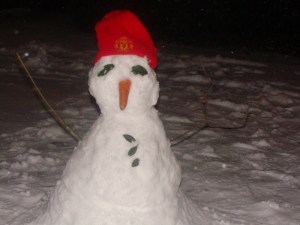
Well, maybe honing is too strong a word.  And it presupposes a skill. Learning would perhaps fit the bill. Meet Snowman Ray.

Snowman Ray. The snowman with a kind heart.

Ok, so he was our first and only attempt last winter. I’m sure he has a very kind heart and a sweet singing voice. Neat handwriting too. And yes, he is a Manchester United fan.

We didn’t have a lot of snow to work with, as you can see, and, well, our hands got cold. The insults that flew through the Facebook world, when we posted photos of Snowman Ray for all to see, were quite voluminous. Poor Ray. I am hoping there won’t be too many less-than-kind-comments in the comments section here.

Before we arrived in London last year, I’d only ever seen snow once before. And that was atop the Alps, in the middle of summer in the mid-1980s. We had taken a cable-car ride up to Mount Titlis and, while the rest of the tourists languished in a heated coffee shop, enjoying hot chocolate and decadent pastries, my husband and I played in the snow. And kept running to thaw out our hands under the hand-driers in the bathroom.

So last December, when the snow fell in London (does it fall or float or both?), I was as excited as a puppy at meal time. The snow continued through January and February. I was working at that time, and I would get so excited when I noticed that snow was falling. I would jump around and say to my colleagues, “Look, look! It’s SNOWING!”

I usually got an indifferent look, an expression of “Whatever,” and was asked if I wanted to lie down until the hysteria passed. It’s a huge novelty for me, you know. Snow, that is. Not hysteria. Although hysteria is too.

So you’re hearing this first: I’m setting myself a challenge  of learning to build a decent-looking snowman. The kind that could feature on a greeting card, rather than be mistaken for a Cape Town taxi guard. Photographs of works in progress coming to a blog near you soon.

Bring on the snow.

Sunshine signing off for today!