Disco fever at the London Sevens

Record crowds of more than 100,000 over two days. Sixteen teams from around the world. Two series’ cup finals. Two streakers and far too many men wearing floral sundresses. It could only be the 2012 London Sevens rugby series at Twickenham.

Twickenham in the sunshine

We were there last weekend to witness it all. Nestled in the north stand in weak sunshine on a chilly May weekend, it was difficult at first to know where to focus our attention. The rugby was fantastic, but the spectacle that is the London Sevens was hard to resist. Every series has a colourful theme; this year’s was ‘70s disco fever’.
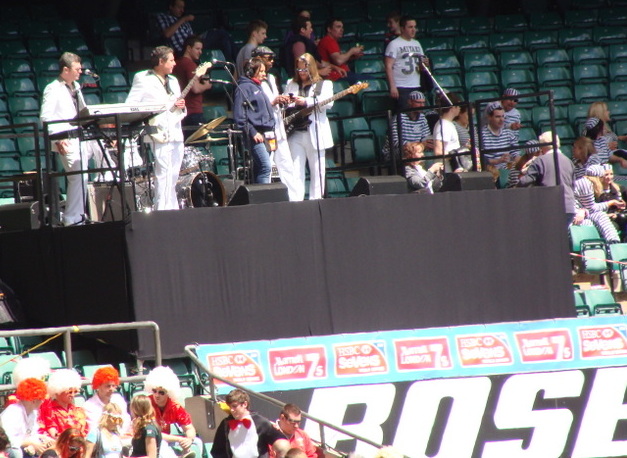
Play that funky music, white boy

I have come to realise that English fans of rugby sevens love to dress up. Most keep to the theme but many seem to keep a fancy-dress outfit at home to suit all occasions. Take the two guys dressed as nuns. They must have thought, “What can we wear for a 70s disco fever theme? I know; our habits. Ace.”

To make it even better, one of the nuns carried a scarecrow with him, who interviewed people as they walked around the stadium on Saturday afternoon. Seventies disco? Bang on.

As we watched the pool games on Saturday, we also saw a team of dancing penguins, a Roman gladiator, two men in kilts, cowboys, doctors, tigers, Eeyores, leprechauns, beachballs, someone wearing a T-shirt that said I heart Will Young and an over-abundance of men dressed in pretty frocks.
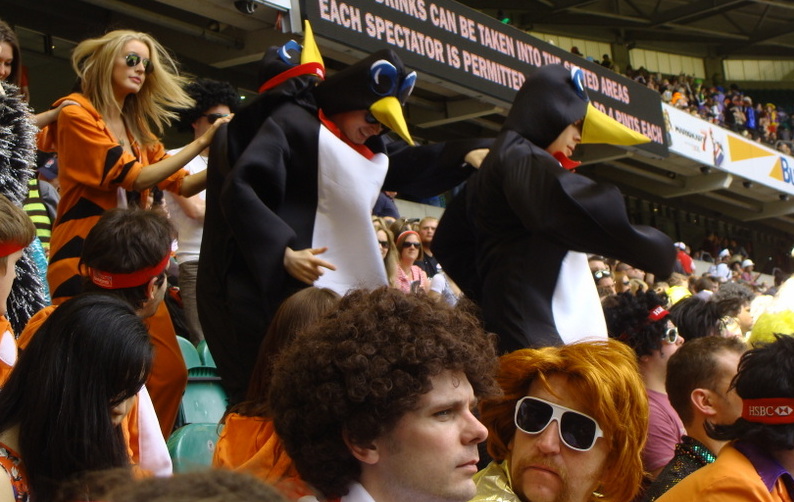
Tigers and penguins dance down the aisles
As I said, way too many men in floral sundresses

The rugby continued regardless, with league leaders New Zealand, Fiji, England and Samoa showing their brilliance. Sadly for us, the South African team felt the loss of their injured star players and barely glimmered in front of an unforgiving crowd. I have noticed that English fans support England, the underdog, and any other country that is not Australia or France.

Naturally biased, fans filled the stands each time the England team came on to play, and the players were heralded on to the field by flag-bearing disco dancers. Equally, after each England game, fans poured out of the stadium. In the England v Australia game, the announcers welcomed each of the English players by name and then, almost begrudgingly added, “And Australia”. For each England try, the fans jumped to their feet, swung their forearms up and down to the annoying tune of ‘do-do-do-do’ – looking around as if to say ‘Did you see that? Did you just see that?’
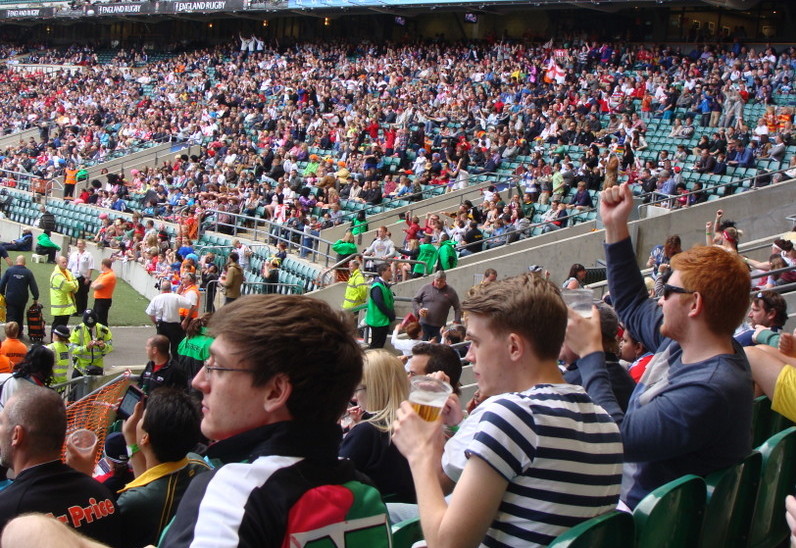
The dying strains of the victory ‘arm shuffle’

When Australia played Portugal, it was clear the home fans would support their European brothers. Australia stood no chance. When one Aussie player broke the line and sprinted for the try line, in the midst booing from around the stadium someone behind us shouted, “No-one likes you!”

Those who kept on-brand with the 70s disco fever theme included the entire cast of Anchorman, complete with a microphone-carrying Ron Burgundy. We saw the Village People everywhere, as well as Kiss, an abundance of large colourful Afro wigs, Saturday Night Fever suits, John McEnroe look-alikes and plenty of headbands, scarves, platform shoes, chest hair, wide lapels and shiny, large-collared shirts.

Mid-afternoon saw a man dressed as a chicken evade security and run an entire lap of the field. When he got to the poles in front of us, he did a forward somersault on the grass before handing himself over to the stadium’s security personnel who tackled him to the ground. Three of them escorted him off the field.

Later in the afternoon, two men broke through security to run along the top of the western stand. One of them was dressed as a banana and the other had taken his kit off entirely. Security personnel closed in on them before running at them and tackling them both to the ground before walking them out of the stadium.

Saturday’s train journey home was epic. We shuffled on to a crowded train in the middle of loud, rowdy and worryingly wobbly fans, including a young woman pushing crisps into her mouth with unfocused concentration. A group of energetic youngsters decided to have a ‘burpy’ competition on the train. They cleared as much space as they could in the standing area and cheered each other on as they dropped to the ground to do press-ups followed by squats and wobbly jumps to their feet.

This soon became difficult, so the competition turned to pole-dancing. Game candidates jumped on to the poles and success was measured according to the number of times they swung around the pole before hitting the ground. Some managed five, others slid roundly to the floor immediately. Three young men dressed as boy scouts strong-armed their way through the crowds to the train’s exits. Banter ensued. The competition organiser told one of them, “You’re the reason I never wanted to be a scout.” The scout retorted with, “Well, with an attitude like that, you’ll never get your pole-dancing badge.”

Sunday’s crowd was subdued. The rugby became serious and hopes of winning cups, shields, bowls and plates were dashed or kept alive. As teams were knocked out, they each did a gracious and well-received lap of honour around the field. Fans clambered for autographs and photographs and the rugby heroes cheerfully obliged. I did notice some players taking off their shorts or socks and handing them over to adoring fans. Seriously.

The sun sank lower in the sky and the play-offs continued in earnest. We had the bonus of watching the final of the Women’s Sevens series between England and Netherlands. It was an excellent match won convincingly by the home side.
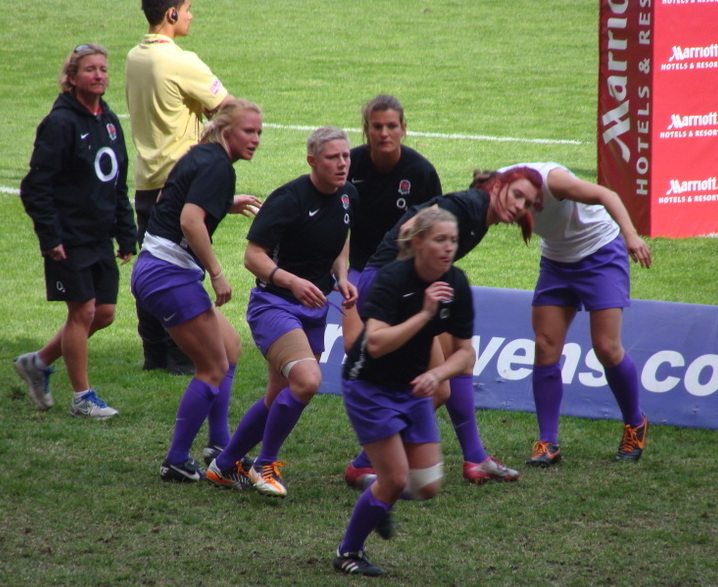
The England women’s team warms up ahead of series’ victory

During half-time in one of the last matches, a female streaker broke through security and ran the length of the field. She, too, stopped in front of the poles and did a cartwheel, to the roaring amusement of the crowd. She walked towards the inevitably approaching security personnel and raised her hands, before side-stepping and running away from them. She was hotly pursued and carefully tackled to the ground before being blanketed in a couple of high-visibility jackets and escorted roughly off the field.

Fiji met Samoa in the cup final and provided one of the most outstanding games of rugby I’ve ever witnessed. Two sides of strong, fast and skilful players entertained the crowd with speedy action, numerous tries and a popular win for a world-class Fiji.

The tired crowd left the stadium and headed, with jaded banter, to a less crowded station than the evening before. We stepped over fake sideburns and moustaches abandoned on the road, and walked alongside a 70s-suited punter who sang flatly as he downed his beer, “Down, down, down, down into my belly!” All around us were filthy bell-bottomed trousers, floppy Afro wigs, faded Smurfs, and floral sundresses tucked into trousers. It was clear the London Sevens of 2012 had come to an end.

Sunshine signing off for today!
Mind the gap

We spent the afternoon in Hyde Park today. We travelled there on the London Underground and were cautioned to ‘mind the gap between the train and the platform’ as we got off at our station.  At Hyde Park we could have done with a similar caution: ‘Mind the gap between the speaker and the heckler’.

We went to the Park especially to hang out for a while at Speakers’ Corner. We’ve often walked past the speakers and wished we could have listened for a while. It’s quite an education, I tell you. Speakers’ Corner is said to date back to 1855 when the government banned any form of buying or selling on a Sunday, the only day working people had off. Public riots broke out and Hyde Park was used as a location for free speech. According to Wikipedia, The riots and agitation for democratic reform encouraged some to force the issue of the “right to speak” in Hyde Park.”

At our first stop at Speakers’ Corner, the speaker was unable to present his case because hecklers were fighting among themselves. Heated exchanges – often reaching fever pitch – between a man from Pakistan and a man from Iraq drew a crowd of people around them. It got mean and it got angry. Somehow, although sounding personal, it seemed not to offend. “YOU’RE A TRAITOR!” followed by, “YOU’VE NEVER WORKED A DAY IN YOUR LIFE.” “ I DIDN’T HAVE TO. MY FATHER’S AN INDUSTRIALIST.” “AN INDUSTRIALIST? WELL, WHO’S HE BEEN STEALING FROM?”

At which point, someone in the crowd appealed for silence to allow ‘the Somalian pirate’ to have his say. And so began the case for Muslim/Israeli religion. Stood on a small soapbox, the gentleman from Somalia began to explain the origins of God and religion. Not long into his monologue, someone shouted to him, “ON A SCALE OF ONE TO TEN, JUST HOW DIFFICULT IS IT TO LEARN TO SPEAK ENGLISH?”

This was followed by an interjection by the man from Pakistan, to which the Speaker said,”Don’t listen to this man. He’s high. He smokes hashish.”

“I buy it from you, my friend,” was the Pakistani’s defence.

We moved along.

We stood and listened to a woman who was being heckled by someone who told her she knew nothing and that she never had anything to say. With spittle flying from her mouth, the speaker berated the heckler’s arrogance, told him that despite the fact that she had stood and spoken there for 20 years and he had stood there and listened, that he was fooling himself if he thought they knew each other or even had any kind of relationship. After five minutes of bickering, someone cried out: “What is your message?”

She told us that politics was finished, religion was finished and the world was finished. We could never know anything, except what we had been fed by the government and what they wanted us to know. And this wasn’t even the truth, but what the government wanted you to believe. She implored us to challenge facts and arrive at our conclusions of what we might discover to be our own truth.

“It’s like if you went to court, and the judge looked at the prosecuted and declared that he didn’t like the look of the guy, so ordered him to be hanged, without hearing the cases for and against him. So it is with the truth – you can’t just make a decision without hearing pros and cons.”

One short-sighted heckler then entered the fray: “What kind of judge is that who makes a decision because of the way the guy looks? That’s a dictatorship.”

We jogged along.

Mr Conservative stood and addressed a small crowd about the myth of the New Society. I wasn’t quite sure of the point he was making, but he talked about the Occupy London protest being meaningless, because the protesters were doing nothing and offering nothing.

“It’s like the media. They go there and they interview the first person they see and they learn nothing. It’s like they get to Westminster, and they think, ‘What shall we do now? I know, let’s go to St Paul’s and do a story about Occupy London’. So they go there, interview the first person they see, post their story and go home to sleep. Job done. Why? Because they’re LAZY!”

After hearing some gratuitous pot shots at political parties, we moved on.

After a short stay listening to a quietly-spoken gentleman promoting the value of the Catholic Church, we stood in the midst of the Sunday afternoon joggers, cyclists, walkers, rollerbladers, buggy-pushers, speakers, hecklers, tourists, photographers, onlookers and students in the beautiful, chilly blue, thin sunshine of a Sunday afternoon in central London.

Two young men approached my son and asked if he’d like to share a few thoughts for a radio programme they were recording. He said to them, “Are you asking me because I’m the first person you saw? Were you in Hyde Park, knowing that you needed to do a programme and not sure what to talk about? So you came to ask me what I thought, so you could go home and go to sleep. Why? Because you’re LAZY!”

Actually, my son just politely declined. Mind the gap between the truth and my imagination.

Sunshine signing off for today!

Dump the old and laugh in the new

It was a humid New Year’s Eve in 1998 in Zimbabwe. Rain was threatening the skies over Bulawayo, and our family was settling into my sister’s home after a wonderful Christmas break at a small, private game reserve outside the city.

There were 22 of us together that year: my parents, my three siblings and all of our families. Some of us stayed at my sister’s house in Bulawayo, and some in friends’ homes around the neighbourhood. We gathered during the day and for meals and outings and arguments; not all of the above were planned. Hey, we’re family.

After a week or two in Bulawayo, we’d spent an amazing five days at the reserve, celebrating Christmas and the rare and welcome opportunity for us all to be together. We arrived at the reserve armed with food and drink to sustain an army. My brother-in-law’s family were at the reserve when we arrived; it was planned that Christmas Day would be our overlap day and 45 of us sat around the same celebratory table for lunch. A marquee doubled as a dormitory for the 18 children in sleeping bags that night, while the adults enjoyed the luxury of sleeping in thatched rondavels (round huts) overlooking a small dam. As they say, it’s hell in Africa.

After a further few idyllic days of horse-riding, fishing, swimming, walking, reading and enjoying good food and family time – including a spontaneous concert that we siblings put on for the incredulous children, and a wonderful awards’ ceremony that one of my brothers orchestrated to mark the unique contribution to the holiday of each one of us – we returned to the city to celebrate New Year together. It was on the day before New Year’s Eve that, one by one, 14 of our clan of 22 fell ill. (My original family plus two sturdy youngsters remained either completely or relatively untouched.) My sister – who is a nurse – took great care of each patient, ensuring everyone was well-hydrated and fever kept at bay.

The next day we took my elder son to see the doctor. Before she examined him, we told her that we had 13 more like him at home; whatever he had, they all had too. Tests revealed that shigella dysentery was, well, running through our family. All 22 of us had to have treatment for this notifiable disease, and so it was that we celebrated the dawn of 1999 quietly and, I guess for the most part, gingerly.

The medicine took effect quickly and within a day or two, all the cousins were gathered around the dining room table sharing stories of their experience of the disease. For the young boys – aged between about 8 and 14 – the conversation was not repeatable, and much laughter rang through the house; it made a change from those other sounds.

Part of the family left soon after the New Year and 12 of us remained to travel to Hwange Game Reserve and Victoria Falls for a few more idyllic days. We travelled in a pack, enjoyed incredible game-viewing and sight-seeing, and found that hysterical laughter can hurt your stomach almost as much as the disease. As we visited two of the most beautiful places on the planet, our memory banks filled with stories that will follow us around our whole lives, and shared memories of joy and discomfort that bonded us in a way you could never imagine.

We’ll never know where the disease came from but we do know that love, laughter, family and brown paper packets filled with bullet-sized tablets took it clean away.

So, as I sit in my London flat on a chilly, grey New Year’s Eve and await the dawn of 2012, it warms my heart to think of this time 13 years ago and all the interesting adventures of our family reunion. We bought a beautiful wooden carving of a giraffe who we named “Relly” (for relatives), and he stands proud in our home (currently in my parents’ home) as a reminder of that holiday.

Reflecting on the past year, I feel anxious to press on into the new. I miss my family and home and friends – I always do at this time of year – and my heart feels heavy with nostalgia. But I guess – like the shigella – that feeling too will pass and I look forward to rediscovering the laughter that will make my belly ache.

As I wish you all a wonderful and happy New Year, and every good blessing for you and your family, what is it that you reflect on at the dawn of this New Year? And what are your hopes for 2012?

Happy New Year to you all. Sunshine signing off for this year!

Let’s eat cake

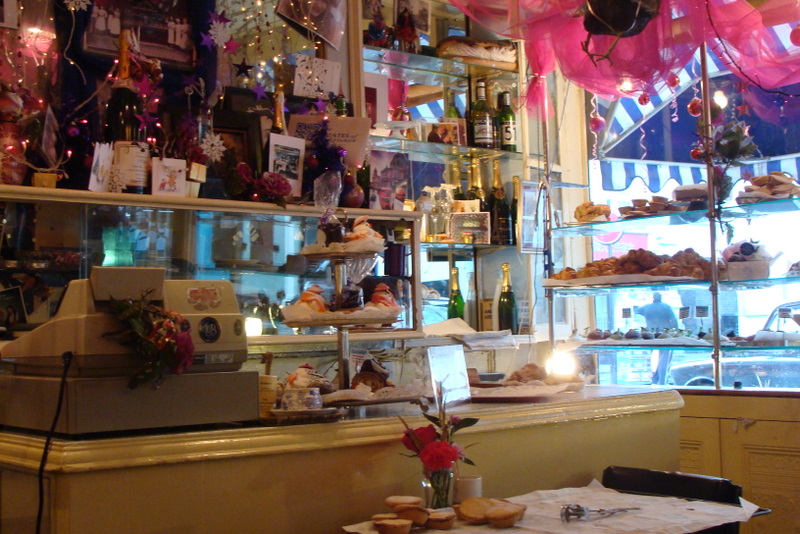
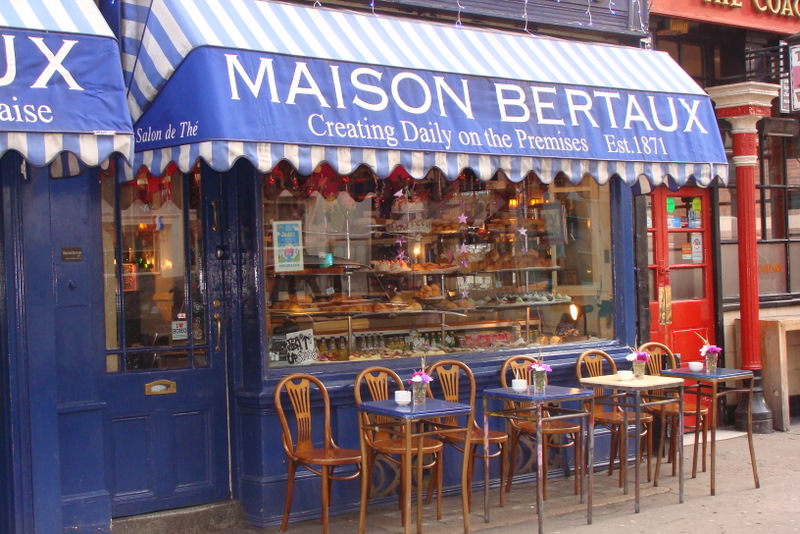
It was quite uncanny. Oxford Street was pumping. It seemed that everyone in London chose to do their Christmas shopping yesterday. And they chose Oxford Street. Two minutes away from the mayhem, we found an oasis that made my heart smile: Maison Bertaux.

We’d walked from the busy high street in central London towards Soho. We walked through Soho Square and a block down from the Square, we found this place:

Maison Bertaux - an original in the heart of Soho

We’d talked about stopping somewhere for coffee and I insisted we try this place – it just looked, well, so un-high street.  It looked like a place that had a story to tell. We weren’t disappointed.

This is what we found when we stepped inside.

A little shop of edible treasures
Everything looks like it has a story to tell
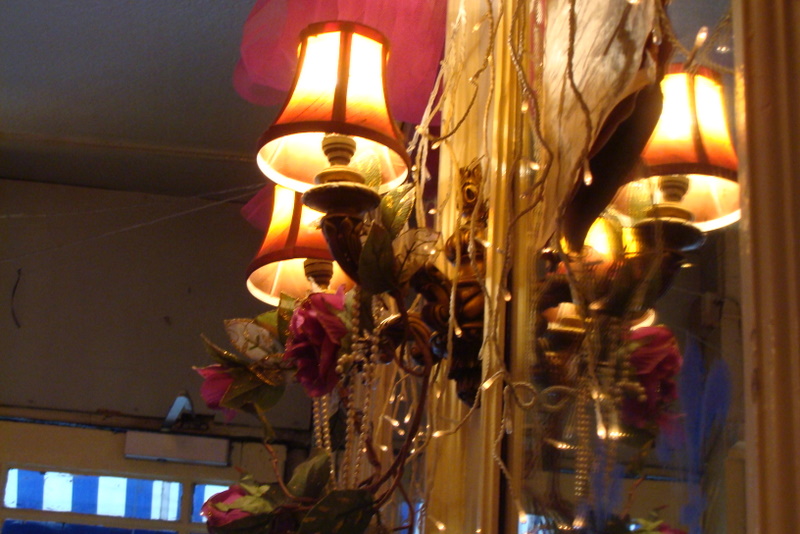
Pink scarves and retro wall-lamps

I didn’t know where to look first – at the ornaments, at the writing on the mirrors, at the decor, at the newspaper clipping of Alexander McQueen, at the cakes, the cheeky meringue snowmen with their chocolate-roll sleighs … then we were asked what we wanted to order. I asked for a filter coffee and a cappuccino and was offered the only two coffees they have on offer: a café noir with milk and a café au lait. Being Christmas, we thought it would be rude not to try the homemade mince pies too.

We sat down at one of two tables in the small downstairs area and waited for our order.

I couldn’t stop staring at everything. One of the waiting staff noticed my curiosity.

“There’s so much to look at,” I said.

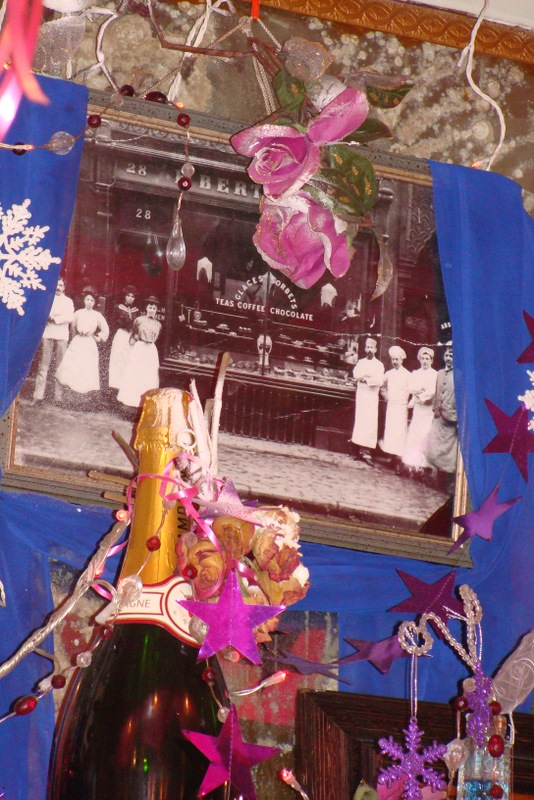
He said the place was full of stuff from the 140 years the cake shop had existed.

An old photo of the newly-opened Maison Bertaux

“Not sure if you can tell that we have our Christmas decorations up, or not,” he said, wryly.

We found our answer when we spotted a small Christmas tree on the piano.

Near to the Christmas tree was a signed copy of Noel Fielding’s book Scribblings of a Madcap Shambleton. A note stuck to the wall suggested there were more where that one came from. Noel is not only a genius, off-beat comedian, but also a regular here.

We chatted to one of the two sisters who own the cake shop. The younger sister of ‘a cross between Margaret Rutherford and Joan of Arc’, she told us the shop had remained the same since its establishment in 1871 – the same cake recipes, everything made fresh – every day – on the premises. She called it not only the oldest cake shop in the country, but also ‘the Ivy of cake shops’ in London, in that it attracts artists, actors and other real celebrities.

“It gets completely mental upstairs sometimes,” she said, as she rattled off names of people who frequent the cake shop.

The old stucco’d walls are grubby and absolutely, antiquely beautiful. The glass shelves behind the counter boast – among ornaments, bottles, scarves and a giant chocolate éclair ornament – a photograph of the shop in its early days. The glass shelves in the window groan with the most beautiful, creative and mouth-watering delights you care to imagine. A stream of white-capped chefs marched through from the kitchen to present their handiwork for the window for the day: trays of fresh-fruit tarts, marzipan figs, gateaux saint-honore, croissants, cakes, éclairs and ‘wormy pies’ (meringues with endless coils of cream). Equally, deliveries of sacks of flour arrived while we were there. It is a working kitchen, for sure.

A taste of Maison Bertaux specialities

We were told about the art on display upstairs. I went to have a quick look at it, but didn’t spend much time as I wanted to leave the few customers up there to enjoy their coffee and books in peace. I also made a quick stop in the ‘wee wee hut’; I was amused and delighted to see the toilet flushed with an ancient pull-chain.

I don’t think much has changed in this gorgeous tea shop since it was established by French communards in 1871. In today’s world of overpriced paper cups filled with have-a-nice-day coffees, and plates filled with cardboard pastries, I was completely entranced by this original gem. So close to the hubbub of the high street yet so far removed in every possible way.

It was pricey, yes, but when you step into an era of genuine tasty quality, creativity and originality in a room full of chaotic, colourful history – what else could you expect? It’s our new favourite tea shop. In the whole world.

Sunshine signing off for today!


Re-telling a winter’s tale

He was born on the winter solstice in Edinburgh in 1926. He died on Christmas Day in 1992, on the warm tip of Africa. A lovely, gentle, talented, troubled, kind soul he was. He was my father-in-law and this is his story.

As life and breath poured into his infant body on that cold and wintry December night in Edinburgh, so life and breath drained from his mother’s. She breathed her last and died that day. Life and loss. His young father was stricken with an overwhelming grief that veiled his joy at this brand new life.

My father-in-law was adopted by a family whose name we now bear. They lived on the island of North Uist in Scotland’s Outer Hebrides. This new family ran a hotel and my father-in-law spent his days living the life of a young, country lad: fishing and hunting and finding the best that the beautiful, bleak, cold island could offer. His days were underlined with sadness and a constant wondering about his father on the mainland. He knew who he was, he knew where he lived and he so longed to meet him.

As a young man he met and fell in love with a beautiful young woman from the mainland. They married and lived on the island, going over to the mainland for the birth of their first son. With the hope and promise of seeking their fortune in Africa, the three of them chose to join her brothers in Zimbabwe (southern Rhodesia as it was known then). He travelled ahead of his wife and son and, before he left, went to Edinburgh to meet his real father. He wondered nervously whether or not his father would welcome him. His fear of rejection turned him around again and off he went to begin a new life in Africa.

Son number two (my husband) was born in Zimbabwe, and the family enjoyed living in the warm, friendly heart of southern Africa. My father-in-law was a talented musician – a self-taught pianist and accordion player – and he played in a Scottish band. He would lose himself in his music, and played the piano with a gentleness of touch that kept me riveted. I often wondered where the music took him as I watched him play. When he died, I inherited his piano. Such a gift it was; such a gift he had.

He loved his sons and watched, with pride, as they grew into young men and created lives of their own. His daughters-in-law became part of his family, and he loved us with a gentle passion I will never forget. His heart beamed as his grandchildren started to appear, and each of them loved their “Pops”, with his ready laughter and unconditional love and pride.

One day, when he was about 60, he received a letter out of the blue. It opened with, “You don’t know me, but we’ve known about you all of our lives…”

The writer of the letter went on to say his father – who was also her father – had been 23 years of age when he was widowed. He’d married again and had had some children, but she didn’t elaborate. She wrote of her father’s longing to meet him, but how, for fear of rejection, he’d never made that happen. She told him his father had died in 1976. Oh the sorrow that both men had felt the same way, and their perceived fears had kept them from ever meeting each other.

The writer ended her letter by saying she’d send more detail of the family if my father-in-law so wished. She also said she’d understand if the communication had made him uncomfortable, and she wouldn’t continue and would, with respect, leave it at that.

Amazed, my father-in-law wrote back straight away, asking to find out more. The next letter brought details of his family tree and he discovered that, at the time of his birth and his mother’s death, he’d had an older sister. She was three years older than him, and was raised in Edinburgh by a grandmother (not sure which grandmother this was). His father had then remarried and had seven daughters and two sons. She shared some detail of the siblings, their names and where they were.

The correspondence continued for a while and it wasn’t long before my father-in-law decided to travel back to Edinburgh to meet his new family. A few siblings travelled across from elsewhere to meet him. Great excitement, anticipation and a huge nervousness were his travel companions.

He spent a number of days with his new-found family of half-siblings, and met his full sister too. This is the part that always gives me goosebumps: his siblings all said, without exception, that having him around was like having their father back in the house. He had the same mannerisms as his father, he coughed like he did, he walked like he did and he talked like he did. If that isn’t one for nature versus nurture, then I don’t know what is.

He returned to Zimbabwe with tales of his new-found family. A man of few words, he had plenty to say as he talked about his family and father and the joy of blood ties. It seemed to fill something of a hole in his heart.

Not long after that, he became ill with emphysema and he struggled with ill-health for the rest of his life. My parents-in-law moved to Cape Town soon after we did, and enjoyed their retirement in the city nestling beneath the beauty of Table Mountain. Our boys have vague memories of their Pops, as they were both very small when he died. My older son, who was four when Pops died, told me Pops had gone to heaven and had been given a brand new body. I loved that thought.

So there it was that we celebrated Christmas in the warm sunshine of a Cape Town day in 1992. And as we celebrated the birth of the Saviour who breathed his first on that day so many years ago, my father-in-law took his last, painful breath and we mourned. Joy and grief. So much joy and grief.

Sunshine signing off for today.

An evening in Coolsville

We spent yesterday evening in Coolsville, with the Duchess herself. She sang her way through the soundtrack to my student days in the early 1980s; listening to classic Rickie Lee Jones live was another awesome, red box experience.

The Duchess of Coolsville, 57, skipped on to the Royal Festival Hall’s stage in trademark brown beret and half an hour late for her Pirates concert. According to the Southbank Centre preview, the queen of pop/jazz/country/soul/R&B/blues/you-name-it, with a career spanning 30 years, maintains an unwavering cool despite a historically difficult personal life which has seen her battle and overcome broken hearts and drug addiction. Her concert featured tracks from her two most successful LPs, Rickie Lee Jones and Pirates, in her only stop in the UK before heading to Paris and Bilbao to round off her short European tour.

She opened with Danny’s All Star Joint to thunderous applause, and went on to dance with her beret through After Hours (12 bars past midnight). Spent, she abandoned her beret along with her water bottle, on the piano.

Rickie Lee Jones is not as tall as I would have imagined. I loved watching her bob and weave around the microphone with, what looked to me like awe and fear, and always, always needing the sound to be perfect.

The audience went crazy to hear the opening bars of Chuck E’s in Love, which the Duchess delivered to perfection before moving into a self-conscious, exquisitely delicate and vulnerable, arms-folded version of Company. A beautiful Easy Money prefaced her move to the piano, where she played and sang for the next hour. Living it Up was followed by a call from Rickie to ‘play some more happy songs’, as she moved on to the hauntingly beautiful clarinet-soloed Skeletons.

Ms Jones’ band is filled with outstanding musicians: a crazy talented lead guitarist, a Duke of Coolsville on bass, a keyboard (piano and Hammond organ) magician, an astounding drummer and ridiculously brilliant three-piece horn section of saxophone/clarinet, trumpet and trombone. Each artist had their moment in the spotlight to share their beautiful talent.

After We Belong Together, Rickie Lee apologised for being late.

“Did you forgive me yet for coming on late? I don’t have any reason, except I wasn’t ready. In so many ways,” she said ironically before moving on to Lucky Guy, filled with pretty, pretty Hammond organ solos. On Saturday Afternoons in 1963 was followed by an emotional, tear-filled outpouring of Coolsville.

The Duchess followed her heart rather than the setlist, which kept the band watching her closely and the setlist frequently being replaced.

She moved on to Pirates and Traces of the Western Slopes before a funky Woody and Dutch on the Slow Train to Peking. Guitar in hand, Ms Jones talked of her first trip to London in 1979 and how everything about the city ‘creeped her out’ as she walked through the ‘emotional chasm of heroine withdrawal. Everything was different, from having only one television channel (‘that played dogs chasing sheep’), to the light switches, to waking up at 3am and everyone was asleep’.

As an apology for that story, she sang a bonus number, a pure-Rickie Lee version of On the Street Where You Live. The Weasel and the White Boy’s Cool rocked the most insane lead guitar solo before Night Train, Young Blood, Last Chance Texaco and After Hours.

Ms Jones wept as she talked of the ‘supreme peace that found me, unexpectedly, on this Pirates tour’. She thought it would be a nightmare, reliving the difficult times through Pirates, but found that she can now ‘go home and sleep at night’.

With emotion and gratitude, she sang the closing number The Returns, leaving us all with a hope that the Duchess of Coolsville will be back. Two hours of pure Rickie Lee Jones magic. Catharsis rocks.

Sunshine signing off for today!

The best is yet to be

She’s feisty and funny, gentle and bossy, kind and loving, generous and caring, scatty and awesome. She talks plenty and laughs even more.

We shared a room through our childhood and memories through forever. We travelled to boarding school together and sat and swung our little, hairy legs from hard benches as we waited in small, random airports in Africa. We’d climb into each other’s beds when the movie was too scary, or we were homesick, or the monster was about to climb out of the tissue box again or if we were just plain scared. We were best friends.

We shared a cigarette when she was ten and I was eight. We took advantage of the babysitter when all he wanted to do was lie on the couch and watch telly; we ran amok through the house and went to bed late and our parents never knew.

We moved from town to town and school to school and it was okay because we always had each other. We wore matching clothes and our patent leather shoes were always filled with mom-knitted cotton socks. We learnt to play the piano together and we trained for swimming in the same big swimming pools.

Ever longing for a career on the big stage, she wrote, produced and directed our early productions which she presented, with a flourish, in front of a packed lounge full of parents and visitors. All four members of the audience were riveted as Rapunzel let down her golden hair from the dizzy heights of the dining room table. She cast me in various productions as a tree and as Queen Victoria and as her production assistant and she always smiled as the dining room doors closed after another well-received ovation.

After school she started a career in nursing, and her carer heart has brought light and joy to everyone she looked after. She married young and has always been a loving and passionate mother to her children.

She’s fought for freedom and her big heart has broken when change hasn’t yet come. She’s spoken on big stages and small, sung at rallies and in meetings, stood by her principles and risked imprisonment for speaking the truth. She uses her beautiful voice for change.

She’s a mother and soon to be a grandmother, she’s a wife and a daughter, a much-loved aunt and an adored sibling.

She’s my big sister and it’s her birthday today. Happy birthday to you, my precious S. You’re one heck of a sister and I look forward to growing old with you.

Occupy London sleeps in peace

I didn’t so much occupy St Paul’s Cathedral today, as sit upon its steps to have my lunch. It was quite the most London experience I’ve had in a long while: bizarre and entirely fascinating.

I crossed the River Thames on the London Millennium Footbridge on what was a sunny, crisp and quite beautiful London day. When I reached the City of London, I came upon a random opinion poll in the form of a Perspex box into which you could place a small, brightly-coloured ball into either of two segments: ‘Carry on protesting’ or ‘Time to go’. A camerawoman sat on the pavement next to the box recording the un-secret ballot, while a suited cohort encouraged passers-by to commit their opinions to Perspex.

I carried on walking towards the Cathedral. My goal was to see ‘Occupy London’ for myself on a significant day in its two week history.   I chose not to take a camera with me, as I wanted to feel the experience; well, as much as I could in a lunch hour.

The grounds of the breathtakingly beautiful cathedral that is St Paul’s were teeming with people: tourists, protesters (although I did eyeball a poster on the outskirts of the property stating, ‘This is not a protest’), non-protesters, lunchtime joggers, office workers, policemen, reporters, students, church clerics and other random passers-by.

I wandered around the tented city for a while. I poked my nose into the information tent, which appeared to be the centre of all knowledge for the temporary home to the anti-corporate-greed activists. I was amused to see practical notices adorning the walls of the tent: ‘Free bio energy healing sessions. 10 minute taster’ and ‘Lost: brown suitcase’.

Helmeted bobbies stood by watching impassively, while television cameras on every corner recorded the events on a day such as this.

There is something of a carnival atmosphere – and, despite the Portaloos, a faint whiff of urine in the air – in the Cathedral grounds; a kind of Woodstock for this generation. Outside the ‘Tent University’ you can read of forthcoming lectures and discussion groups; you can buy books at a bookstall, you can add your written protests to the many stuck to surrounding pillars. You can also ‘Grow your own future’ – the psychedelic and 60s style flower power poster suggests that what you grow might make you not worry about globalisation one jot.

I picked my way through the tented community and went to sit on the steps of the Cathedral. I sat between some young tourists in ‘I love London’ hoodies and sushi-munching bankers. We all sat as spectators to the genuine, peaceful protest against economic inequality.

Baguette in hand, I listened to a group of singers presenting their shaky-voiced and anti-evil-banker version of Blake’s  ‘Jerusalem’ (And did those feet in ancient time). It wasn’t pretty but it was sincere. They had in front of them a hand-painted poster proclaiming the perils of globalisation and the need ‘to keep our souls’ and ‘not be sucked in’.

In something of a sing-off, a black-robed man stood opposite them with arms outstretched and singing his truth as he walked towards the women. I couldn’t hear what he was singing, but his cloak bore the words, ‘Holy Book of Racial Government’. Big banners nearby called out to ‘Mourn the dead. Heal the wounded. End the wars!’

As I slowly wound my way out of the village of peaceful protest, I watched two bobbies chatting to a tourist and a busker. I overheard one of the bobbies explaining to the two exactly what training is involved in becoming a London policeman. As I stood and eavesdropped, I was urged out of the way by a guy pushing a trolley bearing camera equipment. “Hot cakes comin’ through,” he shouted. “Hot cakes comin’ through.”

I realised later that his ‘hot cakes’ must have been on their way to record today’s verdict: the eviction order to force the protesters to leave St Paul’s within 48 hours had been overturned.

It was time to head back to my office. The Perspex box, now much fuller, showed overwhelmingly in favour of ‘Carry on protesting’.  It seems that London had voted with its balls.

Sunshine signing off for today!

In step with today

I don’t know what it is about some days. It’s like they get stuck under my shoe, and no matter how I try, I can’t shake them loose. With every step I tramp awkwardly and feel, for the most part, a little off balance.

I had such a day today.  To say it was frustrating is like saying that Madonna is quite rich. At midday, I decided to try and walk it off. My plan was to take my lunch and go and eat it down by the River Thames.

Having bought my lunch, I walked along a lovely piazza lined by restaurants. I got distracted by a small band setting themselves up in the shade of a leafy plain tree. I sat down in that same shade, and waited to see what would happen next. And the band began to play.

Adam was the lead singer and guitarist; a kind of curly-haired Leonard Cohen. Leonard Cohen on Prozac; slow and poetic, but not as depressing as he could be. He was joined by a violinist and double bass player, and together they played some really interesting, original music.

Soon after I sat down, a young woman sitting next to me lit herself a rolled “cigarette”. I use the word loosely. She took a drag, stood up and put the rollie down where she’d been sitting and disappeared. I watched her disappear out of view, and wondered if I was part of a social experiment. I thought maybe someone was about to come and have a second drag of it, but no. About five minutes later, the young woman returned with a coffee in her hand. Of course.

Next, I saw another young woman, dressed in a bright yellow, lycra, polka dot body suit. She walked past, not without some sniggering from the construction workers sitting near me.  As I looked around for a camera – surely a candid camera moment? – I saw another young woman emerge from the opposite direction on an old-fashioned bicycle with a basket in the front. She had a scarf wrapped around her head and knotted on top, like an old-fashioned washerwoman. She stopped her bike for a short while and stood and watched and listened. She then rode off, with her furry toy penguin strapped in as a pillion passenger.

Adam continued to pour his heart out into the piazza, to very little attention from the lunching majority walking by, or sitting chatting at the local restaurants. After one lively-ish song, a friend of Adam’s shouted out that his last song had sounded “quite happy”. Adam apologised.

Oh, and a chalkboard next to the small wooden stage from which Adam and band played held a stern warning: “No stage diving”.

I sat a bit longer and soaked everything in. I looked at the beautiful late-autumn-sunny London day. The sky was blue, the sun was streaming through the green leaves of the trees, and what I was experiencing could not have been happening anywhere but London. The city that does random, bizarre, funny, unique like no place I’ve known before. I found sunshine in my otherwise grey day, and I remembered the joy of a city such as this.

I walked back to my office. Funny, there was no longer anything under my shoe.

Sunshine signing off for today!

Randomness

Random thoughts. They tie together not at all and appear in “no random order” as I heard someone once say.

This morning on my walk to the bus, I watched a swan as it dipped its head deep into the water right in the corner of the local dock. I stood and watched for a while. Soon it came up, shook its head a little and its forehead was green with algae.

As I rushed home from work to get to my zumba class in time, I wondered if there would be any mail in our letter box. I imagined finding a letter there telling me I’d won a million pounds. You know what my first thought was? Would I still go to zumba?

On my way home from zumba, I saw three young professionals studying the plaque on a small heritage building in the area. One young man, dressed in a suit, hairstyle like a Beatle with long, pointy sideburns, was giggling as I walked by. He pointed at the plaque, and said, “I can’t believe it says erected.”

When we were at the open air concert in Hyde Park a few weeks ago, I discovered an amazing sense of community and the art of mime. I’d forgotten to take with me my note pad and pen, so I could make notes of the concert for my blog. I mimed “pen?” to my friend who was sitting behind us. She made a face as if to say she didn’t have one, and then motioned that she’d ask her friends. After a few minutes, she looked at me and made a disappointed face and showed me her out-turned hands, palms up. No pen. No worries. About two minutes later, the pink-haired lady with every finger nail painted a different colour, who was also sitting behind us, came over to me with a pencil. She’d borrowed it from her bovver-booted husband, and brought it to me. Who ever said mime doesn’t pay?

A relentless eavesdropper, as you know me to be, it was difficult to overhear conversations at the concert, against the backdrop of never-ending music. It was interesting, however, to watch the goings-on all around us anyway. I watched a family of four enjoy a day out in Hyde Park. Endless trips to the bar saw them taking it in turns to bring back pints and Pimms and ciders and spirits. You name it; they knocked them back. They danced and as the day progressed, their dancing became more “uncle- like” and standing upright seemed to be a growing battle for each of them. As dusk darkened the sky, I noticed the husband and wife arguing. She said, “Fine, then.”  And with that, she turned tail and disappeared into the crowd. The daughter appealed to her dad, “She’s just gone. She’s just literally gone.” Dad appeared unperturbed. Oh well.

A few hours later, in the rainy evening, the mother appeared in front of me. I looked at her and smiled, and she said to me, “My whole family’s just fallen out. It’s an absolute nightmare.” I mimed sympathy, and smiled at her some more. She said, “I saw you look at me, so I thought I’d tell you. It’s a nightmare. We’ve all just fallen out.” I asked if they’d arranged to meet up somewhere, and she told me no-one knew where she was and reminded me that it was a “nightmare”. “Oh dear,” was all I could manage. At that point, her husband appeared to our right and said, “Oh, there you are! We’ve been looking for you everywhere!” To which she said, “Is that so?” and turned tail and disappeared back into the crowd. He looked at me, sighed and said, “It’s an absolute nightmare.” You think?

Sunshine signing off for today!